New series: HowLeaders Actually Get Better. This 12-post sprint is about building adaptive capacity: uncomfortable challenges, quick debriefs, real feedback, and psychological safety so stretch ≠ stress. Each post = one move you can use each week. Ready for learning that sticks? let’s go. ⚡
Post 2: Errors Are a Feature, Not a Bug. The traditional view on learning is simple: avoid mistakes. We design training to be seamless, with guardrails and clear paths, assuming that errors are failures of the system or the trainee. But what if we’ve got it backward? What if mistakes aren’t just inevitable, but a necessary ingredient for true expertise?
The foundational principle is this: If nobody is making mistakes, nobody is learning anything new.
This is the philosophy behind Error Management Training (EMT), a scientifically-validated approach that radically shifts the training paradigm.
The Power of Productive Failure
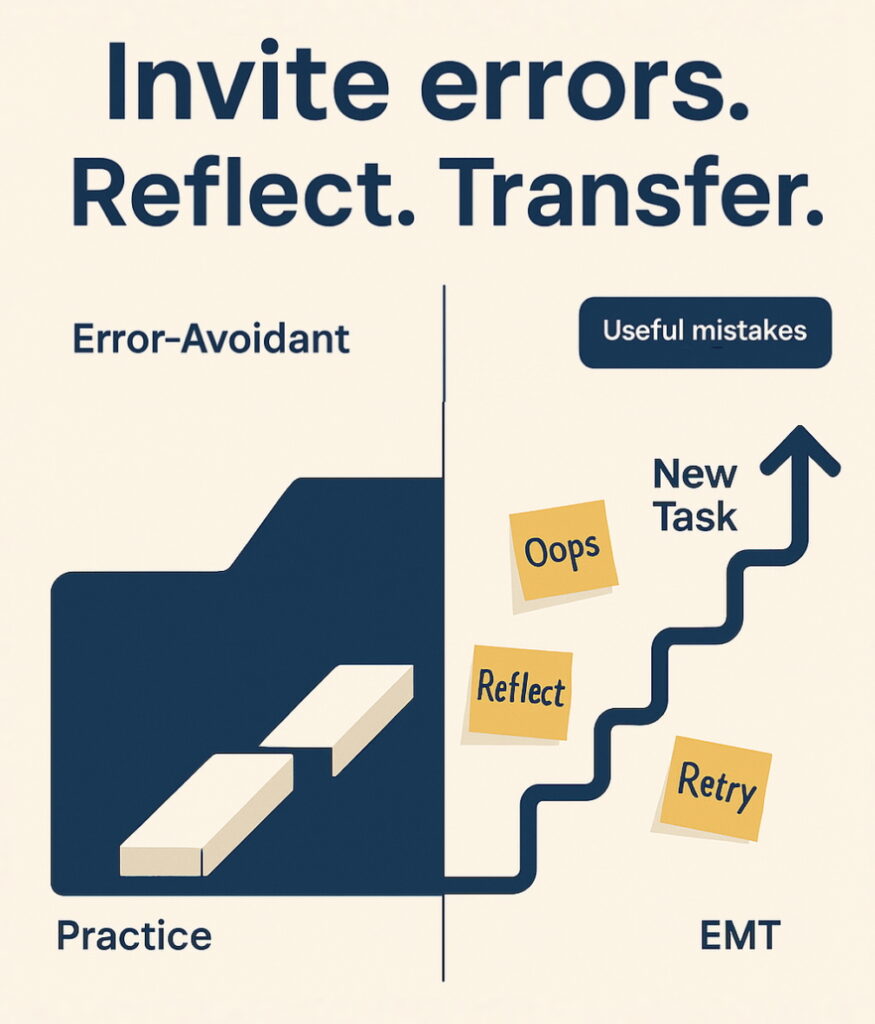
EMT is not about being careless; it’s a deliberate, systematic approach that explicitly invites errors during the practice phase. Trainees are given tasks with minimal initial guidance, practically guaranteeing they will hit a snag.
1. Explicit Invitation: Trainees are told, “You will make errors, and that’s the point.” This removes the stigma and anxiety associated with failure.
2. Paired Reflection: Every error is immediately followed by reflection and self-correction. Trainees aren’t just shown the right answer; they are prompted to analyze why the error occurred, understand the underlying mechanism, and develop a fix.
3. Deep Encoding: This process forces learners to engage with the task at a deeper cognitive level. When you fix a problem you created, the solution is encoded more strongly than if you were just told the answer.
Why EMT Reliably Beats Error-Avoidant Training
Decades of research have shown that EMT is more effective than error-avoidant training, particularly in one critical area: adaptive transfer. Adaptive transfer means the ability to apply learned skills to a completely new or novel situation—the true hallmark of an expert. Studies have shown that EMT boosts adaptive expertise in complex tasks, preparing professionals not just for the common cases, but for the rare and challenging ones.
You can and should build EMT into your operational routines to accelerate team learning and enhance organizational resilience.
By viewing mistakes not as setbacks, but as high-value data points, you shift your culture from blame-avoidance to rapid, proactive learning. The goal is to make errors cheap to find and fast to fix, ensuring that when the real challenge arrives, your team is not just prepared for what they trained for, but ready for the unexpected.